

PP Containers vs PS : Which Material Should Food Businesses Choose?

Choosing a food container starts with the food—not with the cheapest available box. A container for a 25 ml sauce portion solves a very different problem from a clear box for a layered mousse or decorated cake. Two materials you will encounter when shopping for plastic packaging containers are polypropylene (PP) and polystyrene (PS). Both have useful applications, but they are not interchangeable in every situation.
The practical answer: choose a PP container when its verified properties suit a sauce, dip or portioning application; consider a suitable transparent PS container when visibility and shape are essential to presenting a chilled dessert. Always confirm food-contact suitability, temperature limits, closure compatibility and the supplier’s product specifications for the exact item you intend to buy.
What Is a PP Container?
PP stands for polypropylene, a thermoplastic used in many types of packaging and household items. Food businesses may encounter PP in small portion containers, tubs and packaging components. Material identity alone, however, does not establish what every PP product can safely hold, how hot it can get or whether a particular lid seals against spills.
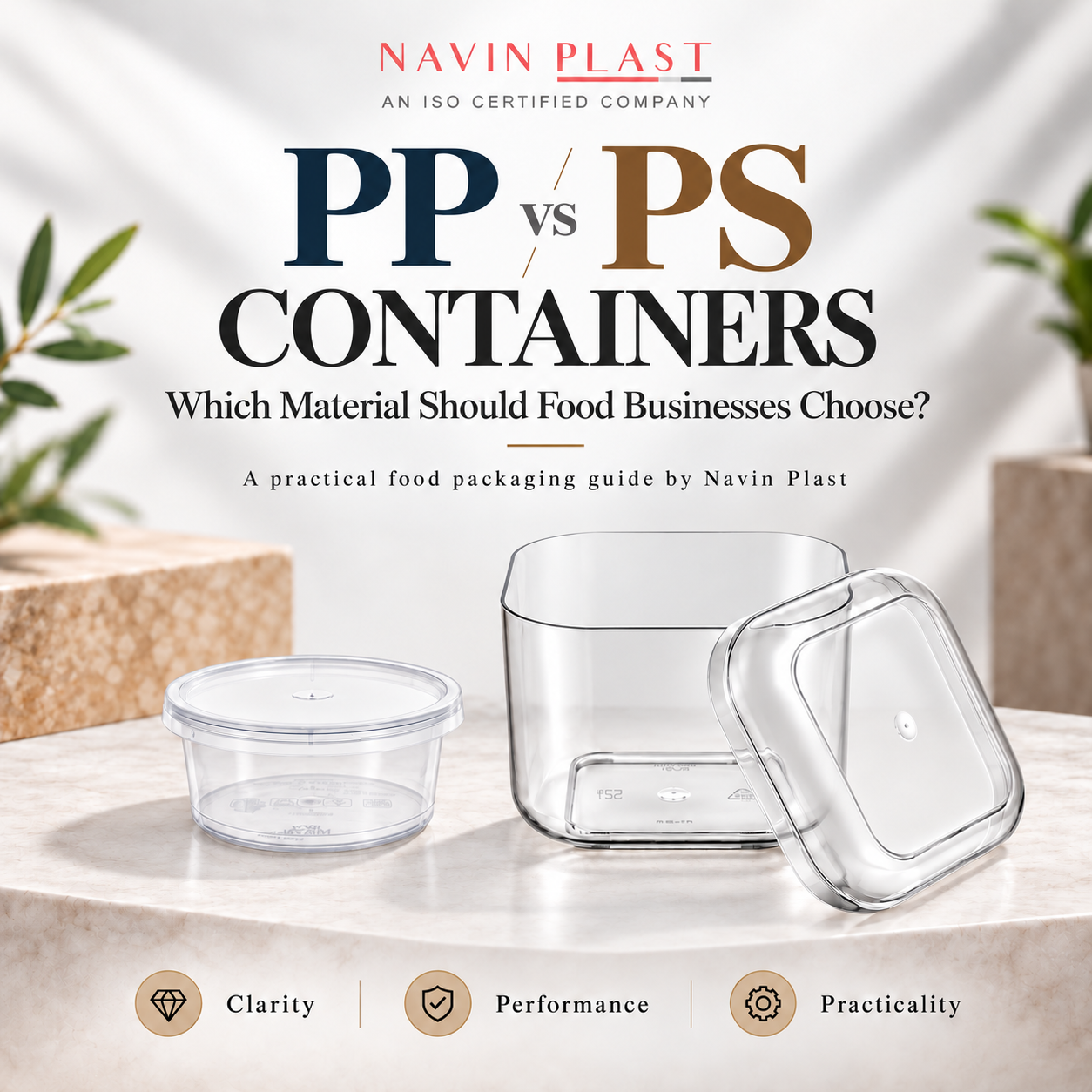
For instance, Navin Plast lists small PP containers in 25 ml, 50 ml and 100 ml capacities. Those sizes make sense when a business needs a defined quantity of sauce, chutney, dip or topping. A café can portion condiments separately instead of allowing liquid ingredients to soak into a food item before serving.
Choose capacity from the recipe, not the label alone
A nominal 50 ml cup does not mean you should fill every recipe exactly to the rim. Foamy toppings, irregular textures and practical handling can require headspace. Prepare a sample using the actual finished food, close the intended lid and move it through your normal packing process before purchasing in volume.
What Is a PS Container?
PS means polystyrene. Manufacturers use different grades and constructions for many applications, including clear serving containers. Navin Plast offers transparent PS dessert formats that showcase layers, toppings and portion detail. A premium-looking food display often depends on a clean outline and a container with appropriate proportions rather than an elaborate printed sleeve.
You should not assume a product made from PS withstands reheating or the same conditions as a PP item. The exact formulation, dimensions, closure design and intended use matter. If you plan to serve hot, oily or reheated foods, ask for written specifications and applicable food-contact information.
PP vs PS Food Containers: The Differences That Matter
Visibility and presentation
A clear container can make mousse layers, colourful toppings and decorative arrangements easier to inspect before purchase. But appearance varies by grade, moulding and surface finish. Compare actual samples under bakery lighting rather than judging the word ‘transparent’ in isolation.
Temperature and intended use
Never select a container using a generic claim such as ‘all PP is microwave-safe’ or ‘all PS is unsafe’. Approval for microwave use requires the specific product to be designed and evaluated for that application. Food composition, reheating duration and container shape affect real exposure conditions. Review product instructions before use.
Rigidity, stacking and closure
Hold a filled sample at its rim and base. Assess whether it flexes too much for your handling process, whether the lid remains aligned, and whether filled units can be stacked without pressing on the food. A container that looks attractive empty may not work once you add a dense dessert or transport multiple orders.
Cost and procurement
Compare cost per usable unit, not only the pack price. Include damaged pieces, mismatched lids, storage space and packing labour. A cheaper container that creates frequent repacking can cost more in daily operations.
Which Material Suits Sauces, Mousse and Bakery Desserts?
Use the food’s behaviour to guide the choice. For a sauce or chutney portion, prioritize measured capacity, appropriate food contact and closure performance. For chilled mousse, prioritize visibility, surface finish, portion shape and lid clearance. For a baked cake, prioritize the usable internal dimensions, stable base and protection for any topping.
Businesses with mixed menus should avoid a one-container-for-everything approach. A standard selection of two or three well-tested formats can simplify storage while still giving different recipes the protection they need.
Are PP Containers Microwave-Safe and Reusable?
There is no reliable yes-or-no answer based on the polymer abbreviation alone. Some products may carry specific heating or reuse guidance, while others do not. Check the manufacturer or supplier’s stated food-contact applications and maximum handling conditions. Reuse also depends on the item’s design, cleaning instructions and condition after washing.
Do not place an unverified container in a microwave merely because another PP product elsewhere has a microwave-safe label. Likewise, do not claim dishwashing, freezer or leakproof performance until the exact SKU supports that claim.
How to Choose Food Packaging for Your Business
Start with a simple worksheet: menu item, served temperature, volume, dimensions, presentation needs, lid requirement, expected handling and target packaging budget. Shortlist a PP or PS format that matches those needs. Order or inspect samples and fill them with the real product.
Next, rehearse the customer’s journey. Close the packaging, place it in a delivery bag or display tray, and check it after ordinary handling. Look for the food touching the lid, trapped moisture, awkward opening and product movement. Record the problems so you can compare the next sample objectively.
Finally, review ongoing supply requirements. Ask about pack quantity, consistent dimensions, replacement lids and the possibility of ordering the same specification again.
A Practical PP vs PS Selection Checklist
Before ordering, verify: the correct material for the declared use; food-contact suitability; suitable temperature instructions; internal measurements; usable portion capacity; closure fit; stacking behaviour; presentation quality; cleaning guidance where reuse is intended; and cost per usable piece. Document your decision so new team members do not unknowingly replace a tested container with a lookalike.
At Navin Plast, browse PP containers for small portion requirements and the broader dessert and plastic container ranges for presentation-led formats. Use photographs and dimensions to shortlist options, then confirm the particular product’s handling suitability before ordering.
Frequently Asked Questions
What is the main difference between PP and PS containers?
They are different polymers with different potential applications. Compare the actual product’s material specifications, temperature instructions, clarity and closure design rather than assuming one material always outperforms the other.
Which material is best for transparent dessert packaging?
Choose the container that presents your specific dessert clearly while providing adequate support and food-contact suitability. Clear PS formats are commonly used for presentation-oriented serving, but product suitability must be verified.
Is every PP container microwave-safe?
No. Microwave suitability depends on the specific product and its tested or stated conditions of use. Follow the supplier’s written guidance.
Can I reuse PP or PS packaging?
Only when the product is designed for the intended repeated use and you can clean and maintain it according to its instructions.
What is the best way to compare two samples?
Fill both with the same recipe, close each lid, check appearance and handling, calculate cost per usable serving and record any defects.
Explore Relevant Navin Plast Packaging
PP containers: https://navinplast.com/product-category/pp-containers/
Food packaging containers: https://navinplast.com/product-category/plastic-container/
Transparent cake and dessert boxes: https://navinplast.com/product-category/cake-box/
Further reading: https://www.fda.gov/regulatory-information/search-fda-guidance-documents/guidance-industry-preparation-premarket-submissions-food-contact-substances-chemistry
Choose for the actual food and journey—not the material abbreviation alone.
